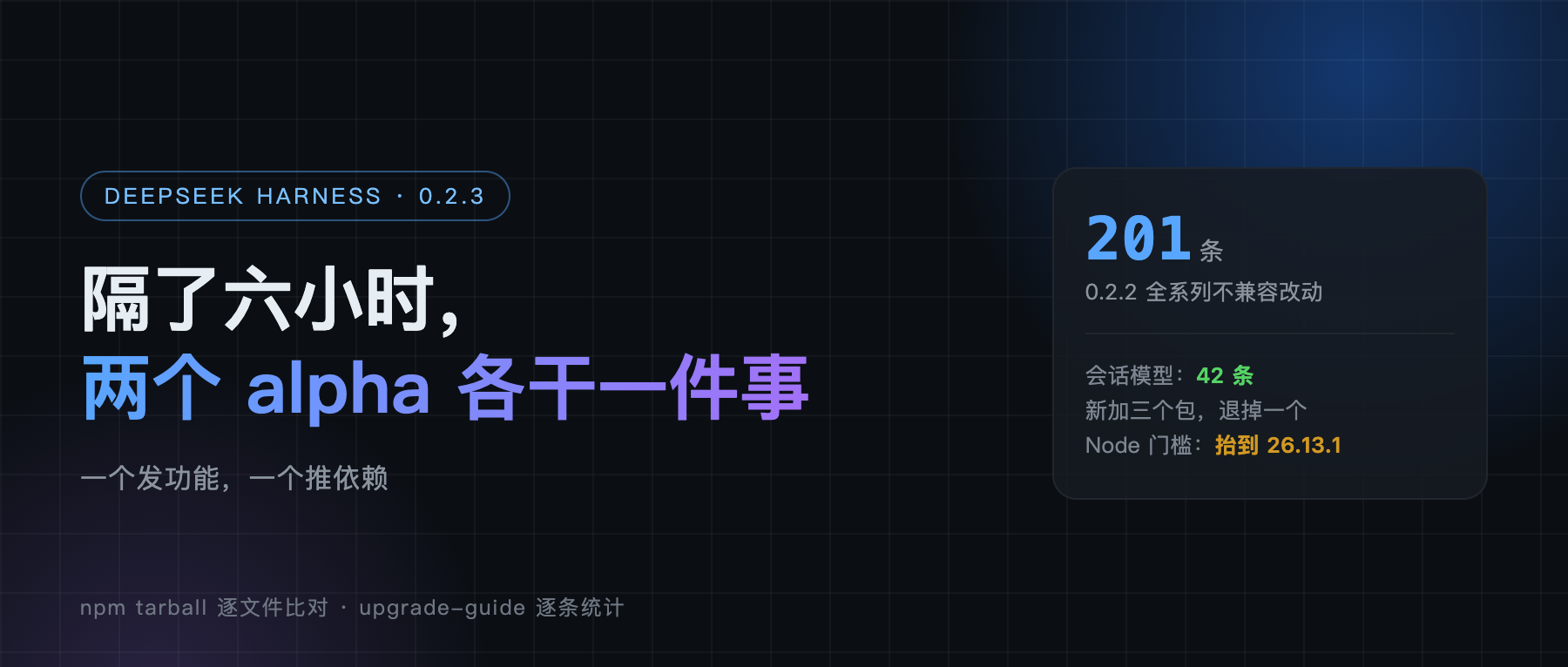
0.2.3 has no stable release yet.
The latest tag on npm still points at 0.2.2-rc.5, published November 18.
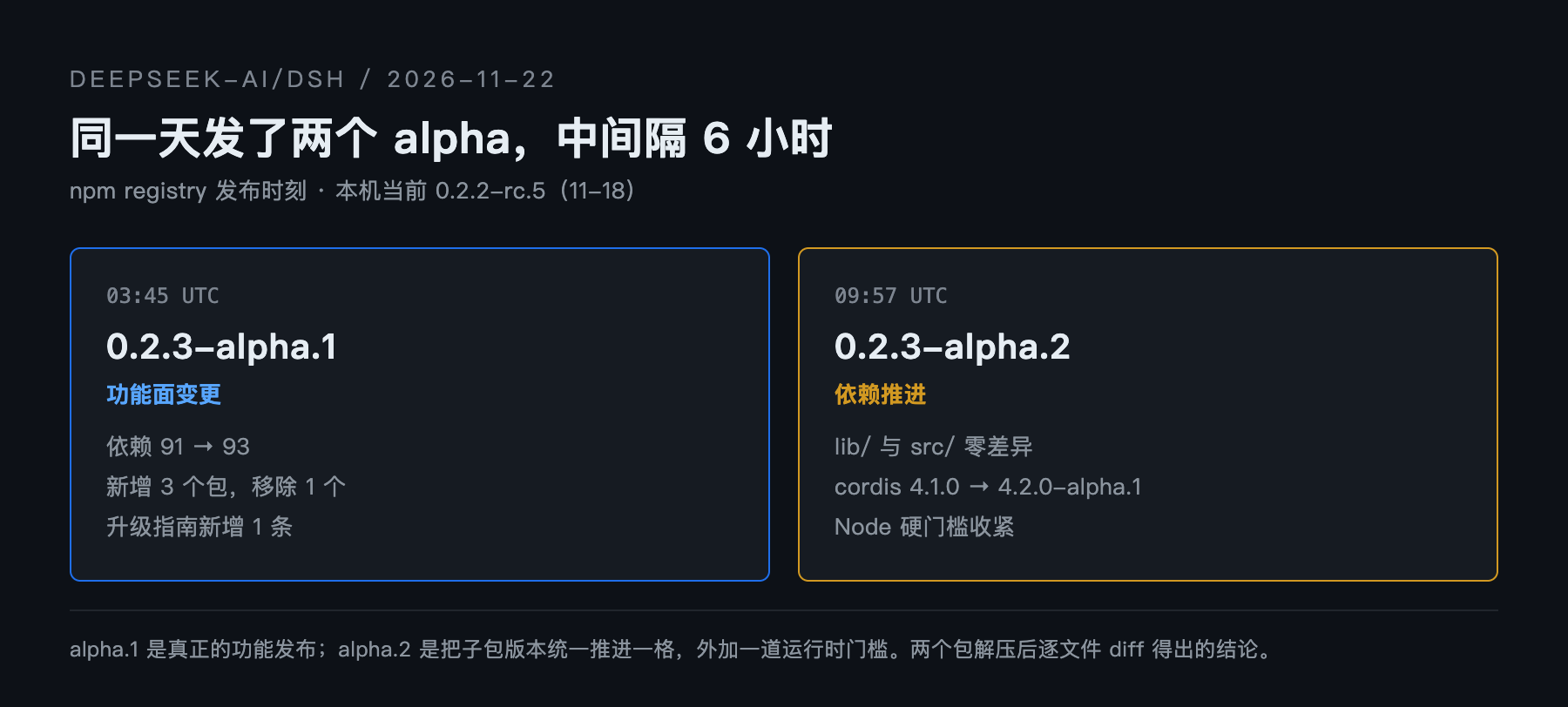
0.2.3 currently has two alphas, both on November 22, six hours apart: alpha.1 at 03:45 UTC, alpha.2 at 09:57 UTC.
No hands-on testing this time. I downloaded both npm tarballs, unpacked them, diffed them file by file, and then took the bundled upgrade guide apart version by version and counted it. Everything below can be traced back to something in those packages.
The short version: one ships features, one bumps dependencies
The two releases have entirely different jobs, and the file level shows it.
alpha.1 against 0.2.2-rc.5: dependencies goes from 91 entries to 93, three packages added, one removed, one new upgrade-guide entry.
alpha.2 against alpha.1: lib/ and src/ are byte-identical. The entire delta is three things.
Every @deepseek-ai/* subpackage version syncs from alpha.1 to alpha.2. node-addon-require-builtin moves from ^0.1.9 to ^0.1.10. engines.node changes from >=24.9.0 to ^24.22.3 || >=26.13.1.
So alpha.1 is the feature release, and alpha.2 moves the subpackage versions up one notch and adds a runtime floor. You need both to see what 0.2.3 is doing.
201 changes, ten directions
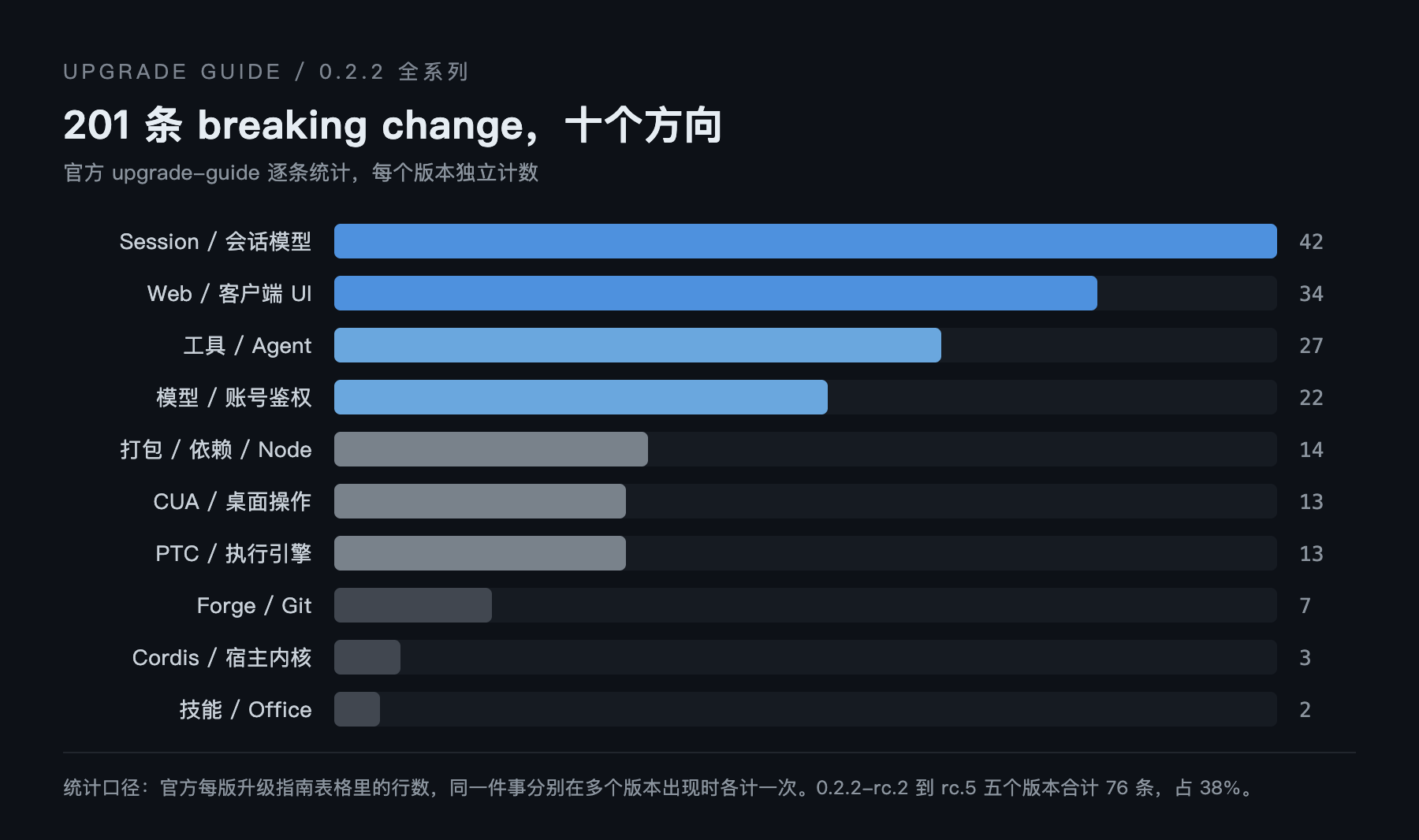
The official upgrade guide runs from v0.1.7-rc.2 all the way to v0.2.3-alpha.1, one table per version. Adding up every row: 201 entries.
Grouped by what each entry describes, ten directions:
Session and the session model 42, web and client UI 34, tools and agents 27, models and account auth 22. Those four account for 62%.
The rest: packaging / dependencies / Node 14, CUA desktop control 13, the PTC execution engine 13, Forge and Git 7, the Cordis host kernel 3, skills and Office 2.
Just from that distribution, the 0.2.2 generation has an obvious centre of gravity: the session model and the client UI together are 37%.
By version:
v0.2.1-rc.2is the single biggest release, 33 entriesv0.2.2-rc.124,v0.2.2-rc.322,v0.2.2-alpha.222v0.2.2-rc.2throughrc.5totals 76 across five releases, 38% of everythingv0.2.3-alpha.1has exactly 1, andalpha.2has 0
That “exactly 1” says a lot: the only externally breaking change in 0.2.3 so far is a Node version requirement. Everything else lives in newly added dependencies — nothing existing was removed or altered.
What those 201 changes were actually about
Not going to read them all out. A few that represent the direction:
The session model took the heaviest beating. v0.2.2-rc.5 removed ctx.sessionQuery.inspectSession — plugins that read cold sessions through a prepared Session object simply stop compiling.
The same release changed how system messages are consumed: consumers now accumulate section updates and recognize notifications by source themselves, instead of receiving a pre-assembled block.
rc.3 was earlier and moved background tasks, subagents and forge change requests out of the session title bar and right sidebar into the session panel. The subagent footer slot retired outright, and the forge tab type went with it.
Auth got rebuilt. v0.2.2-rc.3 requires mounting a new dsh-deepseek-auth plugin and deletes three things: the credential helpers in llm-deepseek, the API key check in dsh-llm, and the router plugin’s config exports.
Every place in old code that read the key directly is void — it goes through ctx.deepseekAuth now.
Search defaults shifted. In v0.2.2-rc.4, shipped bundles no longer pin a search provider, so web search in DeepSeek model sessions falls back from the DeepSeek Search API to the legacy Messages search. Not a bug fix, a trade-off.
The sandbox boundary follows the working directory. In the same release, workspace-write changes from “the original project” to “the Session’s current working directory”. The cost: sessions in a worktree can no longer write the repo’s .git directory.
The tool layer did subtraction. rc.3 replaces create_worktree with a single enter_worktree. The working_directory model tool is removed along with its package and the subagent cwd parameter.
cordis_inspect also lands in that release, replacing both cordis_inspect_list and cordis_inspect_query.
Office skills merged. The built-in office-docx, office-pptx and office-xlsx skills became one office, and three slash commands disappeared with them.
If you wrote same-named skills under ~/.dsh/skills/ to override built-in behaviour, those definitions are now ordinary standalone skills that override nothing.
Taken together, 0.2.2 is tightening the early shape where every feature got a package and every task got a tool.
Tools merging, packages merging, auth consolidating, session data sources unifyings.
The endpoint: what 0.2.3’s three new packages say
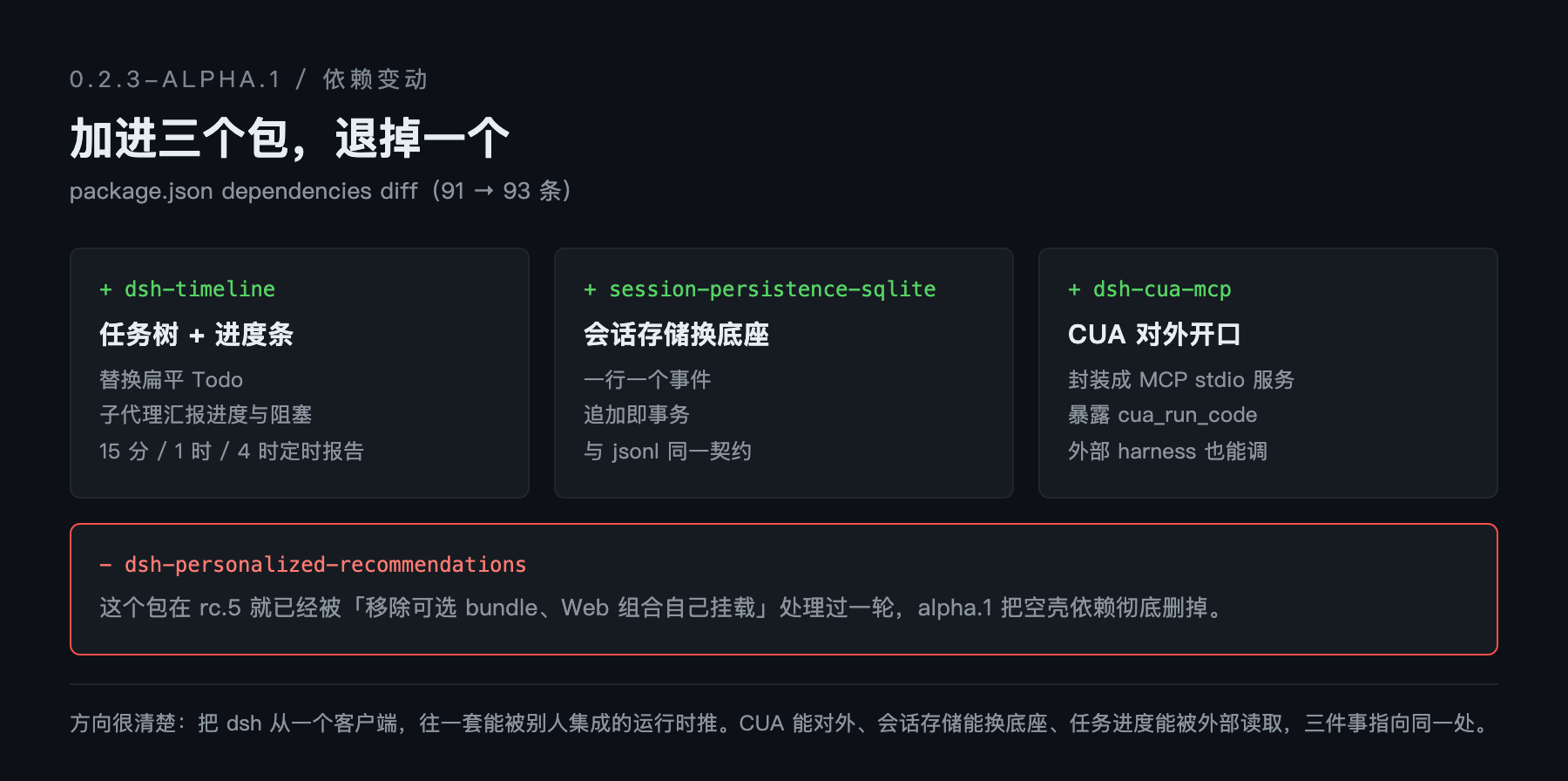
Three new packages, each pointing at one thing.
dsh-timeline: replace Todo with a task tree
The official description: “Replace Todo in long-running sessions with task trees, a live progress bar, and timed reports.” It replaces the flat Todo list in long sessions.
It does more than reskin. The agent breaks work into tasks and subtasks and keeps that plan across turns. Open a task and you see its description, result, blocking reason and change history.
When the main agent delegates to subagents, they report progress and blockers back, and the main agent records results into the same tree.
Progress isn’t counted by task count, it’s weighted. Tasks under the same parent compare by weight — one weight-3 task done plus one weight-1 not started is 75% for that group.
Splitting into finer subtasks doesn’t change the parent’s share. The progress bar has four segments: done, in progress, not started, blocked.
There’s also a threshold: if 24 consecutive iterations in a turn pass without a successful task update, Timeline nudges the agent to record progress. The number is configurable.
Reports come in tiers. Three minimum intervals by default — 15 minutes, 1 hour, 4 hours — and a higher tier folds the lower tier’s reports into one. Reports due while the session is idle get delivered when work resumes.
Task trees export to .timeline.json with progress, weight, priority, change history and discussion; they import back, and --continue picks up where you left off.
To keep working in a new session, use Fork session — the task tree, progress and discussion come along, but reporting history starts fresh from that moment.
The package is officially experimental, off by default; enable it under Plugins → More → Timeline.
dsh-session-persistence-sqlite: a new base for session storage
Sessions used to be append-only jsonl files. Now there’s a SQLite backend too. Both satisfy the same contract: append-only, contiguous sequence numbers, lazy materialization, and closing interrupted turns on load.
The storage model is direct: one SessionEvent is one row in events, (session_id, seq, type, time, data, source_event_seqs, surface_op).
data is the event’s JSON text; the row structure maps one-to-one onto the event, and assistant/chunk lands as rows too, keeping seq contiguous.
Several design decisions are worth noting.
One append is one transaction. append wraps the batch insert in BEGIN/COMMIT; if one event hits the unique constraint on a duplicate seq, the whole batch rolls back, and the in-memory cursor can’t diverge from the on-disk log.
Lazy materialization. create() only records intent in memory, writing no sessions row until the first append. So a session that was created but never appended to is invisible to list().
File permissions are 0700 and 0600. Missing directories are created 0700, the database file is created exclusively 0600, and sidecars like the WAL and shared memory follow the same owner-only permissions.
The upstream docs are clear about the limit: this only guards against accidental exposure from a loose umask, not against another principal that can replace the database file in the same directory.
No migrations. The format isn’t final, so any database whose version doesn’t match is refused, and journal-mode isn’t touched.
locate(meta) returning undefined is deliberate: all sessions share one database, and there’s no honest “one transcript path per session” to hand back.
dsh-cua-mcp: desktop control, exposed outward
This package wraps Computer Use as an MCP stdio server exposing cua_run_code, so external agent harnesses can call it.
Previously CUA only ran inside dsh itself; there was no way to use it from outside. Now it’s a standard MCP service — another harness connects and gets “run a piece of code on this desktop”.
Reading the three together
Session storage can swap its base, task progress can be exported and read externally, desktop control can be served over MCP. All three point at one place: dsh is moving from a client toward a runtime other people can integrate.
The package it removed confirms the same direction.
dsh-personalized-recommendations was already handled once in rc.5: the optional bundle was removed, the web composition mounts those rows itself, it’s on by default, and the toggle moved to Settings → General. alpha.1 deletes the remaining hollow dependency.
Personalized recommendations are a pure client feature — not part of the runtime story.
alpha.2’s one gate: Node
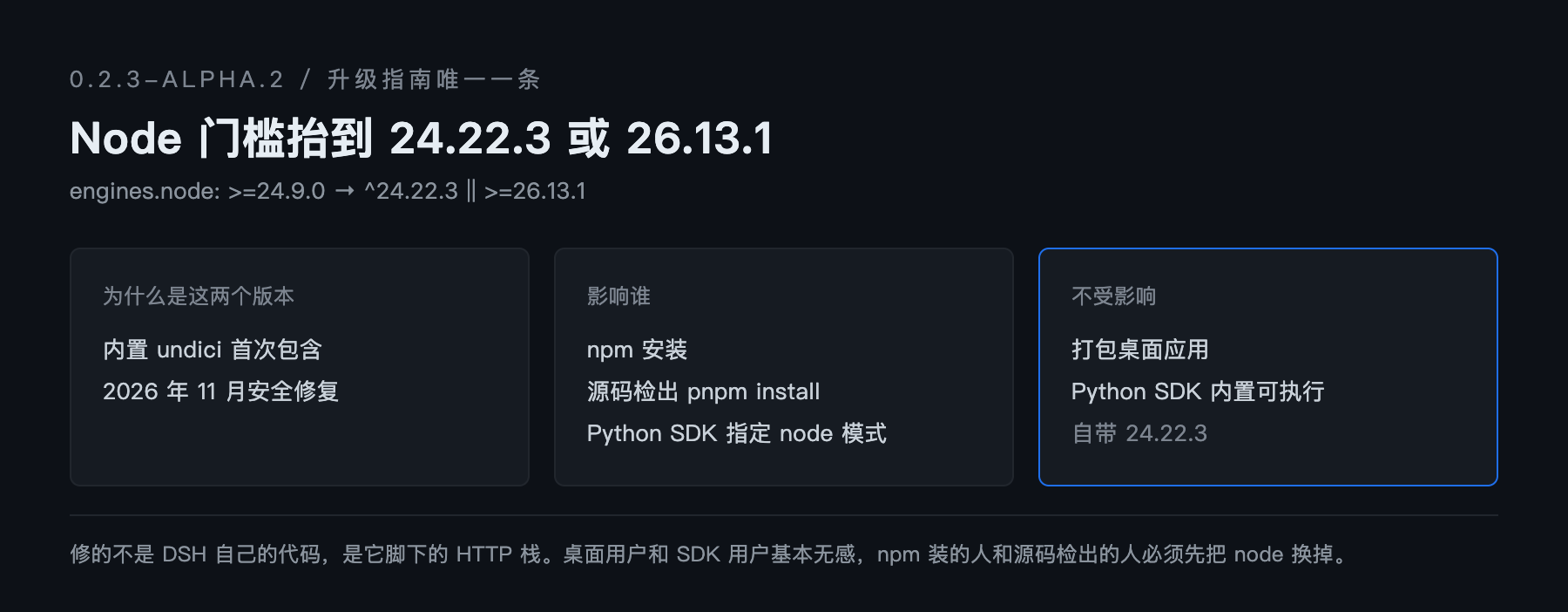
This release’s upgrade guide has exactly one entry, the Node version requirement.
From >=24.9.0 to ^24.22.3 || >=26.13.1. Meaning: the 24.x line needs 24.22.3 or newer, the 26.x line needs 26.13.1 or newer, and earlier 24 and 26 releases are no longer supported.
The stated reason is blunt: these are the first versions whose bundled undici includes the November 2026 security fixes.
alpha.2 isn’t fixing DSH’s own code, it’s fixing the HTTP stack underneath it.
Three categories are affected: npm installs, source checkouts (after pnpm install), and development setups that force the Python SDK’s DSH_RUNTIME_MODE=node. All three need node upgraded first.
Packaged desktop apps and the Python SDK’s bundled executable ship their own 24.22.3 runtime and are unaffected.
One more thing: @deepseek-ai/cordis jumps from ~4.1.0 to ~4.2.0-alpha.1.
4.1.0 shipped November 4; 4.2.0-alpha.1 shipped November 22 at 08:52 UTC, an hour before alpha.2. Cordis is the host kernel of this framework — a major bump means the foundation the whole plugin system stands on is moving.
Upgrade or wait?
My call for my own machine: not yet.
The reasons are right there: latest doesn’t point at 0.2.3, alpha.1 to alpha.2 was six hours, cordis and schemastery are both on alpha branches, and the dependency set is 339 packages.
But dsh-timeline deserves its own look. A task tree, weighted progress, timed reports — those three map exactly onto what breaks in long tasks: the plan scattered across the conversation, progress judged by feel, and no trace of what happened in between.
When it ships stable, I’ll install it first.
So far 0.2.3 adds exactly one external gate, a Node floor, and all functional change lives in new dependencies. That signal is clearer than any changelog: it’s still laying track, not ready for acceptance.
What version is your dsh on? If it’s 0.2.2-rc.5 too, we’re in the same boat, waiting for 0.2.3 to land properly.